Your Android tablet is already a second monitor.

Screen streaming over USB. Sub-10ms latency. Plug-and-play

Get Nomad Screen

A second monitor that was already in your bag.

Nomad Screen extends or mirrors your Mac display directly via USB. Same cable you already own.

USB-C
<10ms End-to-end latency
6-10% CPU usage
~12.0 12h Power (Activity Monitor)
USB AOA 2.0 protocol

Why Nomad Display?

Boost your productivity anywhere

Ultra-Low Latency

Under 10 milliseconds on average. Other apps hit 400–500ms — you feel it.

Wired. Intentionally.

USB-C means lower latency and simultaneous charging. Your tablet charges while you work. No battery wasted. No network configuration, no pairing codes, no router dependency.

A Real Virtual Display

Not mirroring. A true second screen — like plugging in an external monitor, except it's your tablet.

Portrait & Landscape

Flip the tablet and the display follows. Use it landscape or portrait just by turning it in your hand — perfect for reading, code, or timelines.

Configurable Resolutions

Match your tablet's native resolution or adjust for optimal quality. Works with low DPI displays and every aspect ratio too.

Configurable Video Profiles

From Low power 30fps 1Mbps to High quality 60fps 20mbps to adapt your needs.

How it works

Three steps to streaming.

01

Open the Mac app

Launch Nomad Screen on your Mac.

02

Connect the cable

Plug in your USB-C cable between Mac and Android.

03

Click Start Streaming

The Android app opens automatically if configured, and your screen appears instantly.

Automation

Works with macOS Shortcuts.

DualTab exposes a full set of native Shortcuts actions — so you can automate your second screen however you like. Start streaming when you plug in. Switch resolution with a hotkey. Set a video profile for your workflow. All without touching the app.

Combine with other Shortcuts on your Mac or iPad for seamless focus modes, desk setups, or presentation flows.
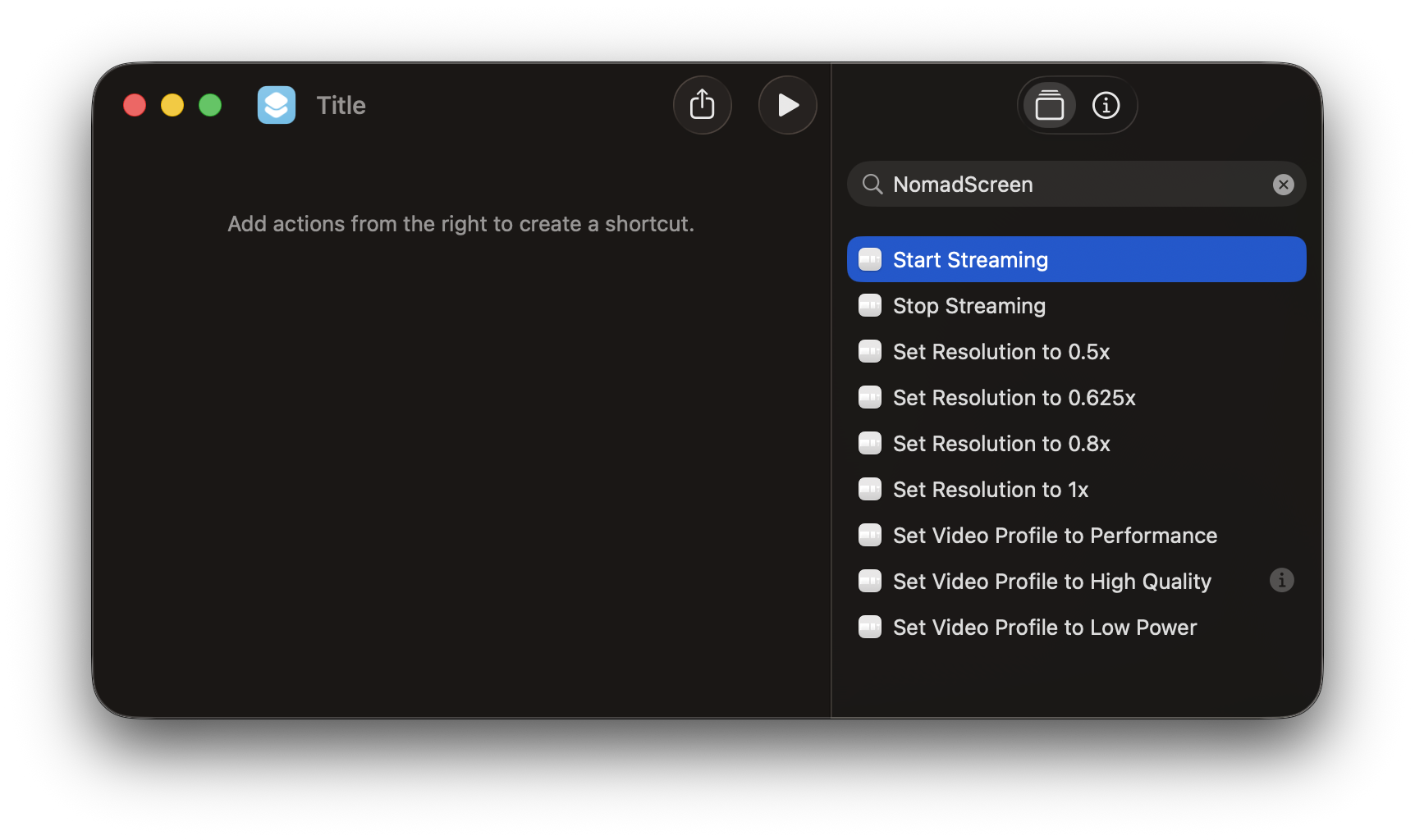
macOS Shortcuts integration

Available now.

Mac app is free. Android is a one-time purchase. No subscription, no account needed.

macOS 13+ · Android 9+ · USB cable required

First time?

How to open the app for the first time

Because this app isn't downloaded from the App Store, your Mac will block it the first time.

  1. Double-click the app — you'll see a message saying it can't be opened. Click OK
  2. Open Privacy & Security (Apple menu → System Settings → Privacy & Security)
  3. Scroll down until you see the app listed as blocked, then click Open Anyway
  4. Enter your Mac password when asked, then click Open
  5. You only need to do this once — after that it opens normally

Learn more about opening apps from the internet on Mac

FAQ

Common questions

Why do I need to allow the app in Privacy & Security on the first launch?

Apps outside the App Store are blocked by default on macOS as a security measure. This isn't a quirk — it's a protective barrier that ensures no background software can run without your explicit permission. Nomad Screen is built with this boundary in mind: it only activates when you start a session, and it never runs background services. You'll only see this prompt once.

Why does Nomad Screen need screen recording permissions?

To create a virtual display that your Mac recognizes as a second monitor, the app needs to capture what's on your screen — the same way a screenshot or screen recording works. This permission is required only for capturing the display content that gets streamed to your tablet. The app doesn't record, store, or transmit anything else. You can verify this yourself at any time in Activity Monitor — the app shows negligible memory usage and no outbound network activity.

Why do I need an extra Android app to have my tablet screen mirror my Mac?

Unlike HDMI cables or standard AirPlay, Nomad Screen uses the Android Open Accessory (AOA) protocol over USB. This requires a companion app on your Android device to handle receiving the video stream, managing the USB connection, and rendering frames to your tablet's display. The Android app is purpose-built for this — it's lightweight, runs only when connected, and handles the heavy lifting that your Mac app sends over the wire.

Is there a plan for wireless connection?

The app is intentionally designed to give the best latency and quality over cable. USB-C enables consistent throughput that Wi-Fi simply can't match — no interference, no compression artifacts, no dropped frames when your network gets busy. Most wireless screen streaming apps struggle with stability and lag. Nomad Screen prioritizes a reliable, responsive experience, and cable is the only way we can guarantee sub-10ms latency.

Will the app receive future updates?

Improvements and bug fixes are always on the roadmap. New features are carefully considered — Nomad Screen operates on a one-time payment philosophy, not a subscription model, so we build only what genuinely improves the core experience rather than chasing novelty. Minimum permissions, stability, and reliability are the top priorities.

Will the Android app support touch input from the tablet to the Mac?

Touch input is on the roadmap, but only when it's stable enough to meet our standards. Other apps offer this feature, but it tends to be laggy and inconsistent — we won't ship something that feels broken. The goal is Sidecar-level quality without an iPad. When it works perfectly, you'll have a second display you can actually write and draw on, not just glance at.